Formulation matters, but “most products do not work” needs evidence
DHM has absorption challenges in preclinical research, which makes formulation a legitimate topic to investigate. That does not establish that most supplements fail or that one brand has solved every relevant problem. Those broader statements would require clear definitions, representative product testing, and human outcomes that match the claim.
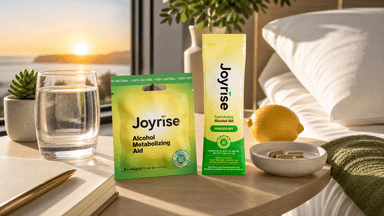
This guide explains how to compare supplements without collapsing several questions into one. Ingredient identity, amount, dissolution, exposure, and consumer benefit each need their own evidence. Joyrise uses a patented delivery approach designed around DHM bioavailability, but a patent alone does not prove a superior result. The company sells the products discussed here, so its commercial interest should remain visible.
Extract weight and DHM amount can be different
A label may list a botanical extract, a quantity of DHM, or both. The weight of an extract describes the whole material; it does not necessarily identify the amount of one constituent. Standardization can help explain that relationship when the manufacturer states what was measured. The plant identity and amount per serving also matter.
For example, two labels with the same large milligram number may refer to different things. One could describe an extract and another the compound itself. This is a reason to read Supplement Facts rather than rank products by the front panel. NIH LiverTox's overview provides background on DHM and its botanical sources; the retail label supplies the particular product details.
Solubility, bioavailability, and efficacy answer different questions
Solubility concerns how a substance dissolves under specified conditions. Bioavailability concerns how much reaches systemic circulation and how quickly. Efficacy concerns an effect on a defined outcome. Improving a formulation characteristic can be relevant without proving a symptom benefit, and an effect in one setting may not transfer unchanged to another.
This distinction makes technical claims easier to check. A laboratory dissolution test should identify the medium and methods. An exposure study should name the formulation, route, dose, comparator, and measured time course. A clinical claim should name the participants and outcome. A single phrase such as “advanced delivery” cannot substitute for all three kinds of evidence.
What the mouse absorption study actually compared
A 2021 study of DHM and its metabolites in mice compared oral and injected administration and measured exposure in serum and brain. The results illustrate why route and exposure matter when interpreting DHM experiments. They do not provide a head-to-head clinical comparison of every commercially available capsule, packet, powder, or liquid.
An injected experimental dose bypasses parts of the digestive process. It should not be treated as an oral serving recommendation, nor should its result be assigned to an unrelated branded delivery system. If a product makes a numerical absorption claim, ask for the study of that exact formulation and comparator. A number borrowed from a different experiment can be technically real but commercially misleading.
A larger serving is not automatically the better choice
More milligrams can mean more ingredient consumed without establishing a better balance of benefit and tolerability. Other ingredients may also increase as the serving increases. A useful comparison therefore asks what the complete formula supplies and whether a relevant human study supports the claimed outcome, rather than assuming a larger front-label number wins.
Keep experimental dosing separate from product directions. Research may use a different species, administration route, duration, or population. None of those conditions should become an instruction to take extra capsules. For Joyrise, follow one labeled serving in the intended use window, as specified for the format purchased. An old article suggesting an extra bedtime serving should not override the current label.
What a patent and quality test can establish
A patent concerns an invention. It may describe a formulation approach worth evaluating, but patent status is not an independent clinical trial and does not promise the same outcome for every customer. A responsible product explanation should make the delivery approach understandable while keeping the evidence for actual consumer benefit separate.
Quality testing can answer questions about identity, potency, or contaminants. The NIH Office of Dietary Supplements consumer guide explains that quality seals do not guarantee a product is safe or effective. Look for what was measured, whether the report applies to the relevant batch, and who performed it. A certificate of analysis may be useful without testing absorption or symptom relief. Read the scope of the test before relying on a broad testing badge.
Compare the format you will actually use
A bottle, a packet of capsules, and a powder stick differ in convenience and serving presentation. Those differences can be meaningful without requiring a claim of clinical superiority. Count labeled servings, not just capsules or sachets, when calculating price. Include subscription terms, shipping, and the current return policy if those affect the purchase.
Do not assume the directions for one format apply to another. Check the actual label, other ingredients, and any relevant warnings. When comparing brands, identify the specific SKU because companies often sell separate hydration, pain-relief, and DHM products. The DHM capsule guide and product-format comparison explain how those distinctions affect a practical decision.
Where Joyrise's formulation claim belongs
Joyrise describes a patented delivery approach intended to support DHM bioavailability. The current capsule page provides the product and label context, while the science page links research. Neither should be read as proof that every other DHM supplement is ineffective or that a Joyrise serving has a guaranteed result.
Ingredient research is one part of the story. A claim about the finished product needs evidence about the finished product, with the outcome and comparator stated. That standard makes a comparison more useful to someone deciding whether the format, directions, and evidence fit their needs. It also avoids treating customer preferences as a substitute for clinical findings.
Questions readers ask
Is a liquid always better absorbed than a capsule?
No universal ranking follows from the format name. The formula, dose, and actual exposure study matter. A liquid can be convenient without having demonstrated a better human outcome than a specific capsule.
Can better absorption make drinking safe?
No. Joyrise does not lower BAC, reverse impairment, or make drinking safer. An absorption claim is not evidence of protection from alcohol-related harm, and no supplement makes driving after drinking safe.
What is the most useful question for a manufacturer?
Ask which study tested the exact current formulation, at what dose, against which comparator, in what population, and for which outcome. A clear answer gives you something concrete to evaluate beyond a headline.
Important: These statements have not been evaluated by the FDA. Joyrise is not intended to diagnose, treat, cure, or prevent any disease. Follow the exact product label. Joyrise does not reduce impairment or BAC.
Source trail
References and further reading.
Links are preserved from the article so readers can inspect the underlying material. A link does not mean every finding applies to Joyrise or predicts a finished-product outcome.
Suggested citation
Joyrise Science Team. “DHM Absorption and Formulation: How to Compare Supplements.” The Joyrise Journal, September 18, 2025. https://www.joyrise.com/blog/why-most-dhm-supplements-don-t-work-and-how-joyrise-fixed-it