
Compare capsule choices
Before choosing a capsule supplement, distinguish its packaging terms and directions from medication claims and warnings.
Remedies and supplements guide
Compare hangover remedies and supplements, including hydration, food, DHM, acetaldehyde support, and Joyrise's patented alcohol metabolism support.
Hangover remedies and dietary supplements are not a single category. Separate comfort measures, medicines, hydration products, and DHM supplements, then check the evidence and warnings for each. None provides a shortcut to sobriety.
Explore the topic
Updated
Before choosing a capsule supplement, distinguish its packaging terms and directions from medication claims and warnings.
Ask what a product claims to change: thirst, a headache, alertness, an enzyme measurement, or a customer's overall symptom score. These outcomes are not equivalent. ‘Detox’ and ‘recovery’ can be vague marketing terms. A meaningful claim names the intervention, the people studied, and the result measured, while acknowledging the limits of the evidence.
Water and food if tolerated can support comfort; sleep matters because alcohol can fragment rest. None is a rapid way to reverse intoxication. Keep the next day's schedule realistic and avoid treating a product as permission to ignore fatigue or poor coordination. Choosing less alcohol on the next occasion addresses exposure more directly than expanding a recovery kit.
An OTC pain-relief product is governed by its Drug Facts, including interactions and warnings. A supplement's label does not make it interchangeable with that medicine. Alcohol and acetaminophen can pose liver risks, and aspirin or ibuprofen can irritate the stomach. Ask a pharmacist about a specific product and situation instead of combining familiar brand names without reading their ingredients.
Dihydromyricetin is a flavonoid studied in alcohol-related enzyme and neural-signaling models. Those research questions are different from proving that a consumer supplement cures a hangover. Acetaldehyde processing is part of alcohol metabolism, while next-day symptoms can have several causes. The cited rodent and cell findings are context for evaluating claims, not a guarantee of benefit.
Sources: Shen et al., 2012: DHM and alcohol-related signaling; Does dihydromyricetin impact alcohol metabolism?
Absorption research can support questions about how a molecule is delivered. It does not justify assigning the same performance improvement to every product with a similar ingredient. Compare the formulation actually studied with the one being sold and look for clear methods. A patent, an ingredient certificate, and a human outcomes study answer different questions.
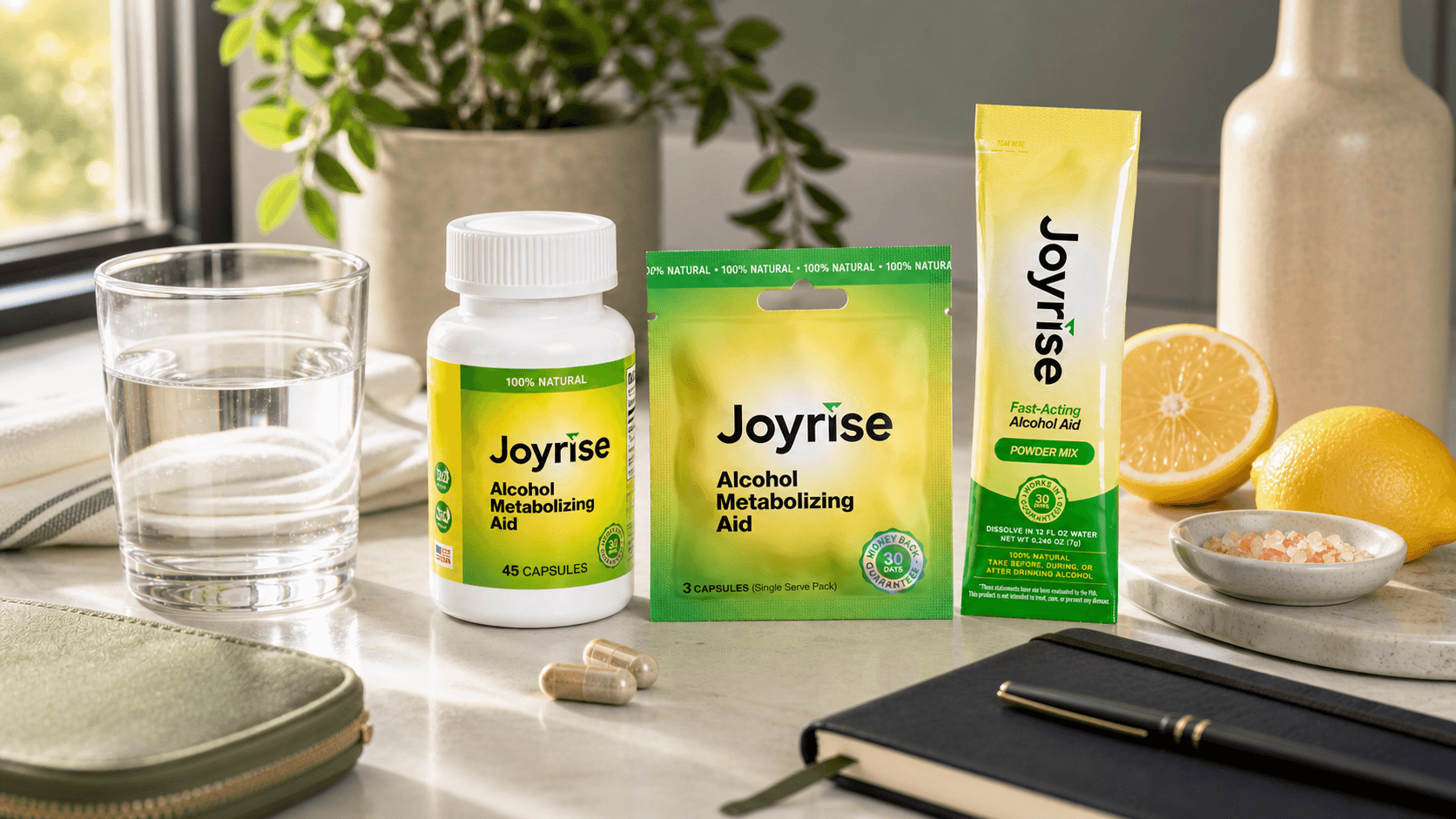
Joyrise offers bottles, capsule packets, and powder sticks. Check the exact label, serving count, and preparation before deciding which fits travel or an evening at home. Use one labeled serving in the chosen window. Keep a record of what you take, and do not stack additional servings or another supplement simply because a symptom remains.
Sources: Joyrise capsule product and current label; Current Joyrise formats and prices
Public-health guidance, research methods, and current labels provide different kinds of evidence. Manufacturer descriptions establish product details, not clinical results.
No. The phrase can include food and water, medicines, hydration products, and dietary supplements. Each has different evidence, instructions, and limitations.
Joyrise does not lower BAC or reverse impairment. Do not use a supplement or how alert you feel to judge whether you can drive.
Ingredients, serving limits, and warnings can overlap. More products do not establish better results and can make the total intake harder to assess.
Capsule packets and powder sticks are portable options. Capsules need water for taking them; powder sticks need the preparation specified on their own label.
Three formats. One responsible ritual.
Joyrise does not reduce impairment or BAC and does not make drinking safer. Never drink and drive.