Low-quality alcohol supplements are defined as products that use undisclosed ingredient doses, unverified sourcing, or misleading health claims to appear effective while delivering little to no real support. The alcohol supplement market has expanded rapidly, and with that growth comes a flood of products that exploit vague labeling and bold promises. Knowing how to spot low-quality alcohol supplements protects both your health and your wallet. Ingredients like DHM (dihydromyricetin), NAC (N-acetyl cysteine), and milk thistle each have research-backed dose ranges. Products that hide those doses or exaggerate their effects are not worth your money or your trust. Joyrise is built on the opposite principle: transparent dosing, peer-reviewed science, and third-party verified purity.
What label and ingredient signs indicate a low-quality alcohol supplement?
The single most reliable red flag on any supplement label is the phrase “proprietary blend” without individual ingredient amounts listed. Proprietary blends without dosages are considered a hallmark of low-quality products because they allow manufacturers to include tiny, ineffective amounts of expensive ingredients while padding the formula with cheap fillers. You have no way to verify whether the dose you are getting is therapeutic or trivial.
Effective dose ranges matter. DHM (dihydromyricetin), the natural flavonoid derived from Ampelopsis grossedentata (vine tea), has been studied at doses of 150 to 600 mgfor alcohol metabolism support. NAC is typically studied at 600 to 1,200 mg. A product listing either ingredient without a milligram amount is almost certainly delivering a sub-therapeutic dose. That is not a minor issue. It means the product is functionally inert for its stated purpose.
Ingredient form and extract ratios are equally telling. Milk thistle, for example, should specify silymarin content, ideally at 70 to 80% standardization. A label that reads “milk thistle extract” with no further detail tells you nothing about potency. The same applies to B-vitamin forms: methylcobalamin (B12) and pyridoxal-5-phosphate (B6) are the bioavailable forms. Cheaper cyanocobalamin and pyridoxine hydrochloride are less efficiently utilized by the body.
Watch for claims like “neutralize alcohol,” “block alcohol absorption,” or “support after-drinking recovery.” These phrases are not just marketing exaggerations. Supplements claiming to support after-drinking recovery violate FDA regulations, and any product making such claims is signaling that it prioritizes sales copy over scientific honesty. Legitimate products support metabolism and liver function. They do not override physiology.
Flip the bottle over before you read the front. The Supplement Facts panel on the back tells you everything the front label is designed to hide. If you cannot find individual milligram amounts for every active ingredient, put it back.
How to verify supplement authenticity and quality beyond the label
Third-party certification is the most objective quality signal available to consumers. Seals from NSF International, USP (United States Pharmacopeia), BSCG (Banned Substances Control Group), and Informed-Sport confirm that an independent laboratory has tested the product for ingredient accuracy, potency, and contaminant levels. Third-party certifications like NSF and USP distinguish quality products from poor ones in a market where self-reported quality claims are unverifiable.
Beyond the seal, look for a QR code or batch number that links to a Certificate of Analysis (CoA). A CoA is a lab document showing the actual tested levels of each ingredient in that specific production batch. Brands that publish batch-specific CoAs are demonstrating a level of transparency that most low-quality manufacturers cannot or will not match. If a brand’s website has no CoA access and no way to contact their quality team, that absence is itself a data point.
Physical inspection catches problems that labels cannot hide:
Inconsistent pill size or color within the same bottle signals poor manufacturing controls.
Sticky residue, unusual odor, or crumbling tablets indicate moisture exposure or degraded ingredients.
Missing lot number or expiration date on the bottle itself (not just the outer box) makes quality tracing impossible. Lot numbers and expiration dates on the bottle are required for legitimate recall and potency tracking.
No manufacturer address or contact information on the label is a regulatory violation and a serious warning sign.
Price is also a signal, not a guarantee. Price per dose far below industry norms reliably indicates inferior ingredients or inaccurate dosing. A 30-serving DHM supplement priced at $8 is not a bargain. It is a budget formula with budget ingredients. That said, expensive does not automatically mean effective. Price should be evaluated alongside certification, dosing transparency, and sourcing.
Search the brand name plus “Certificate of Analysis” before you buy online. Reputable brands make their CoAs publicly accessible or send them on request within 24 hours. If a brand cannot produce one, move on.
What marketing traps and false claims should you watch for?
No supplement can negate the physiological effects of alcohol. Hangover severity is determined primarily by alcohol volume consumed, individual metabolic rate, hydration status, and sleep quality. Any product claiming to “block,” “neutralize,” or “detox” alcohol is making a claim that has no regulatory or scientific basis. No supplement reverses alcohol liver injury at scale in human clinical trials, and experts advise significant skepticism toward bold social media claims.
The most common marketing traps in 2026 include:
“Detox” language: No supplement supports liver metabolism. The liver is the cleanup crew. It does not need a supplement to perform its core function, and products claiming otherwise are exploiting a misunderstanding of liver physiology.
Convenience store placement: Products sold at gas stations and convenience stores are rarely third-party tested. They are formulated for impulse purchase, not efficacy.
Social media influencer endorsements without ingredient disclosure: An influencer holding a product is not evidence. Look for the Supplement Facts panel, not the caption.
“All-natural” without specifics: Natural origin does not equal safety or efficacy. Arsenic is natural. The claim means nothing without sourcing details and standardized extract ratios.
Supplements lacking clear warnings about pregnancy, breastfeeding, or drug interactions are another red flag. Potent herbs and high-dose vitamins carry real interaction risks. A product with no contraindication language is either formulated at doses too low to matter or is omitting safety information it should be required to include.
Filler ingredients are a related concern. Undeclared compounds and bulking agents in poorly manufactured supplements can place unnecessary stress on the liver, which is the opposite of the stated goal. Proprietary blends can conceal fillers that undermine efficacy and potentially harm the organ the product claims to support.
How to choose quality alcohol supplements safely: a step-by-step approach
Evaluating alcohol supplement effectiveness before purchase does not require a chemistry degree. It requires a consistent process applied every time you shop, whether online or in a store.
Know your target ingredients and doses before you shop. DHM at 150 to 600 mg, NAC at 600 to 1,200 mg (taken before drinking, not after, since NAC after alcohol may increase liver toxicity), and standardized milk thistle are the most studied options. Write these down or save them to your phone.
Check the Supplement Facts panel first. Confirm every active ingredient has a listed milligram amount. If any ingredient is grouped under a proprietary blend, the product fails this step immediately.
Look for a third-party certification seal. NSF, USP, BSCG, or Informed-Sport seals on the label confirm independent testing. No seal does not automatically disqualify a product, but it raises the verification burden significantly.
Scan the QR code or search for the CoA. Batch-specific lab results confirm that what is on the label is actually in the bottle at the stated potency.
Calculate price per dose and compare. A quality DHM supplement with 30 servings typically costs between $25 and $55. Anything significantly below that range warrants extra scrutiny of the ingredient panel.
Check for complete labeling. Manufacturer name, address, lot number, expiration date, and contraindication warnings should all be present on the bottle itself, not just the outer packaging.
Consult a pharmacist or physician if you take medications. DHM, NAC, and milk thistle can interact with certain drugs, including acetaminophen and some anticoagulants. A five-minute conversation with a pharmacist is worth more than any label claim.
When evaluating best alcohol supplements reviews online, filter for reviews that mention specific ingredients and doses rather than general “it worked” testimonials. Dose-specific feedback is far more informative for evaluating alcohol supplement effectiveness.
How to avoid common mistakes and troubleshoot suspicious supplements
The most common mistake consumers make is trusting a proprietary blend because the brand looks credible. Packaging quality is not a proxy for formula quality. A well-designed label on a poorly formulated product is still a poorly formulated product.
If a supplement you already own is missing an expiration date or lot number on the bottle, do not use it. Absence of lot numbers makes it impossible to trace the product’s origin or verify it was not part of a recall. Contact the manufacturer directly. If they cannot provide batch documentation, return the product.
Suspicious products can be reported to the FDA’s MedWatch program or to the retailer directly. Retailers have compliance obligations and will often pull a product from shelves if a consumer flags a labeling violation. The FTC also accepts complaints about deceptive supplement advertising.
“Naturopathic experts acknowledge that supplements like NAC and B-complex provide only small support edges. Lifestyle basics, including hydration, food, and sleep, remain the primary factors in next-morning recovery.” Useful Vitamins
That context matters. Quality supplements are support tools, not substitutes for responsible drinking habits. The best products on the market, including those built around peer-reviewed DHM research, are honest about what they can and cannot do.
Key takeaways
Identifying poor alcohol supplements comes down to three non-negotiable criteria: disclosed ingredient doses, third-party testing verification, and the absence of regulatory violations like “cure” or “detox” claims.
What the supplement market gets wrong about transparency
At Joyrise, we review a significant number of alcohol support products as part of our ongoing formulation research. The pattern we see most often is not outright fraud. It is strategic ambiguity. A brand lists DHM on the label, uses credible-sounding language, and prices the product competitively. What the label does not tell you is that the DHM dose is 25 mg buried inside a 400 mg proprietary blend. That is not a supplement. That is a marketing exercise.
The supplement industry’s self-regulation problem is real. The FDA does not pre-approve dietary supplements before they reach shelves, which means the verification burden falls entirely on the consumer. That is not a comfortable position to be in, but it is the reality. The tools to protect yourself exist: CoAs, third-party seals, dose transparency, and basic label literacy. The brands that make those tools easy to access are the ones worth trusting.
We built Joyrise around DHM (dihydromyricetin) because the science on this molecule is the most compelling we have found in the alcohol support category. The DHM research base includes peer-reviewed studies on acetaldehyde metabolism, Nrf2 antioxidant pathway activation, and liver function support. We publish our formulation rationale, our ingredient sourcing, and our dose reasoning because we think consumers deserve that information before they buy, not after.
The uncomfortable truth about this market is that most products are not dangerous. They are just useless. And useless products that cost $40 a bottle are a form of harm too.
— Joyrise
Why Joyrise is built differently
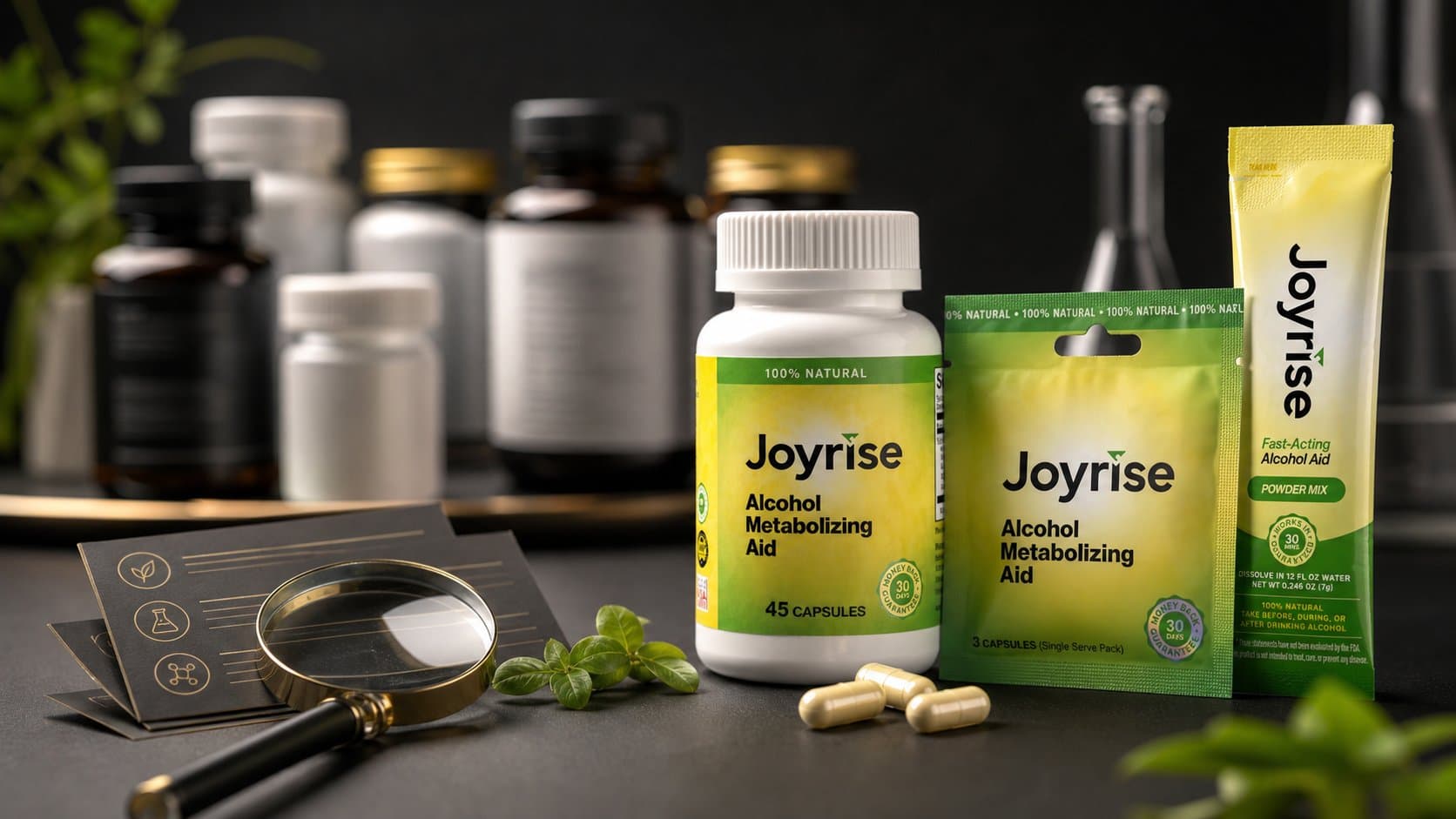
Joyrise formulates every product around standardized DHM at research-backed doses, with full ingredient transparency and no proprietary blend concealment. Each batch is third-party tested for potency and purity, and CoA documentation is available on request. The Joyrise hangover relief capsulesdeliver DHM alongside complementary ingredients at disclosed, therapeutic doses, so you know exactly what you are taking and why. Whether you prefer capsules or gummies, every format is designed for consistent absorption and next-morning clarity support. If you want to understand the science behind the formula before you buy, the full DHM research overview walks through the peer-reviewed studies in plain language.
FAQ
What makes a proprietary blend a red flag in supplements?
A proprietary blend lists multiple ingredients under a single combined weight without disclosing individual doses. This makes it impossible to verify whether any ingredient is present at a therapeutic amount.
Which third-party certifications should I look for on alcohol supplements?
NSF International, USP, BSCG, and Informed-Sport are the most credible seals. Each confirms independent laboratory testing for ingredient accuracy and contaminant safety.
What is the effective dose range for DHM in alcohol support supplements?
DHM (dihydromyricetin) has been studied at 150 to 600 mg for alcohol metabolism and liver function support. Products listing DHM without a milligram amount are unlikely to deliver a meaningful dose.
Can any supplement cure or support after-drinking recovery?
No supplement can cure or support after-drinking recovery. Hangover severity depends on alcohol volume, individual metabolism, hydration, and sleep. Any product claiming otherwise violates FDA guidelines.
How do I report a suspicious alcohol supplement?
You can report labeling violations or adverse effects to the FDA’s MedWatch program at FDA MedWatch reporting page. You can also file a complaint with the FTC if the product uses deceptive advertising claims.
Recommended
Hangover Pills and DHM Capsules | Joyrise
Hangover Remedies and Supplements | DHM Guide | Joyrise
The Silent Protector: DHM Beyond Alcohol
Hangover Relief Products Compared | Joyrise DHM Alcohol Support
Designed for alcohol metabolism support. Made by Joyrise®.
Related: the science/ what is DHM/ DHM hangover relief/ hangover relief capsules.
Important: These statements have not been evaluated by the FDA. Joyrise is not intended to diagnose, treat, cure, or prevent any disease. Follow the exact product label. Joyrise does not reduce impairment or BAC.
Source trail
References and further reading.
Links are preserved from the article so readers can inspect the underlying material. A link does not mean every finding applies to Joyrise or predicts a finished-product outcome.
Suggested citation
Joyrise Science Team. “How to Spot Low-Quality Alcohol Supplements in 2026.” The Joyrise Journal, June 8, 2026. https://www.joyrise.com/blog/how-to-spot-low-quality-alcohol-supplements-in-2026