What can liver research actually establish?
DHM has been investigated in research involving liver metabolism, cellular stress, and metabolic disease. Some of that research involves people, while much of the wider literature uses cells or animals. These are reasons to examine the evidence carefully. They are not a basis for calling a consumer supplement a shield against alcohol damage or a treatment for liver disease.
The original topic behind this article was liver research beyond alcohol. That distinction remains useful: a study in people with a metabolic liver condition is not automatically a study of social drinkers, hangovers, or the finished Joyrise formula. This review keeps those populations separate so that a promising finding does not become a promise it was never designed to test.
The liver's work is broader than a detox slogan
The liver processes nutrients and many substances circulating through the body. In the alcohol pathway, alcohol dehydrogenase helps convert ethanol to acetaldehyde, and aldehyde dehydrogenase helps convert acetaldehyde to acetate. NIAAA explains these metabolic steps. The existence of the pathway does not mean taking an ingredient speeds it enough to make drinking safer.
Liver health also cannot be read from next-morning comfort. Someone may feel relatively well without knowing what is happening to a blood marker or tissue. Conversely, feeling unwell after drinking does not diagnose liver disease. Symptoms, exposure, laboratory findings, and a medical diagnosis describe different kinds of information and should not be substituted for one another.
What the 2015 human trial tested
A randomized, double-blind trial published in 2015 enrolled 60 adults with nonalcoholic fatty liver disease. Participants received oral DHM or placebo over three months. The studied regimen supplied 600 mg of DHM per day. Researchers assessed liver-related and metabolic markers and reported improvements in several measured outcomes in the DHM group.
This was a condition-specific human study, not a hangover trial. Its dose is reported here to identify the intervention, not as instructions for a Joyrise product. The population, treatment duration, formulation, and selected markers limit how far the results can be generalized. A small trial is also not enough by itself to establish routine treatment or long-term disease prevention.
A newer trial used a combination product
A 2026 randomized study in metabolic dysfunction-associated steatotic liver disease examined a marketed combination supplement over 12 months. The tablets included DHM, choline, vitamin C, and vitamin E. That detail matters: the trial was not a test of Joyrise, and a multi-ingredient intervention cannot simply be relabeled as evidence for DHM alone.
When reading this or another combination trial, check the prespecified primary endpoint before selecting an attractive secondary result. Look at the comparison with placebo, the number of people completing follow-up, and whether the result addresses symptoms, laboratory values, imaging, or clinical disease. Even a useful result in one of those categories does not establish every other outcome.
Why laboratory pathways still matter
Cell and animal experiments help researchers ask more focused questions about metabolism and cellular responses. Terms such as oxidative stress, antioxidant signaling, and autophagy describe processes that can be investigated under controlled conditions. They can generate a hypothesis worth testing in people without establishing that a purchased supplement prevents tissue damage.
For example, an experiment may measure a change in an enzyme or signaling protein after a defined exposure. The useful interpretation names the model, treatment, and endpoint. Calling that result “liver protection” without those details can hide the gap between a laboratory observation and a clinically meaningful benefit. Mechanistic interest and consumer proof are different stages of evidence.
Safety evidence is not an all-purpose clearance
NIH LiverTox's DHM overview discusses the ingredient and the available liver-safety record. A lack of established reports of a particular injury is different from comprehensive proof of safety in every population, at every dose, or with every medicine. The number and design of human studies still matter when interpreting reassurance.
People with diagnosed liver disease, abnormal tests, or questions about medicines need individualized advice. A supplement label cannot determine the cause of a laboratory abnormality. Do not discontinue prescribed treatment or substitute a supplement for an evaluation. Bring the complete ingredient list to a clinician or pharmacist rather than assuming the botanical name tells them everything in the bottle.
How to read a liver-support label
Start with the ingredient identity and amount per serving. Extract weight is not always the same as the amount of a specific compound, and products may add other botanicals or nutrients. Then distinguish testing for identity and contaminants from a human efficacy trial. Both can be useful, but they answer different purchasing questions.
Ask whether a cited study used the exact commercial formula and whether its population resembles the intended user. A statement about a patented delivery approach should be linked to formulation evidence, rather than used as a substitute for clinical outcomes. Finally, keep serving instructions attached to the actual product; research regimens are not interchangeable with retail directions.
Where Joyrise fits, and where it does not
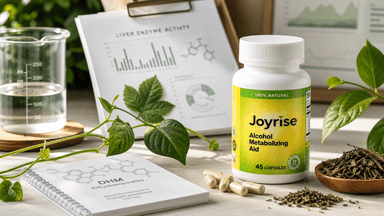
Joyrise's role is dietary supplementation for alcohol metabolism support. It does not treat fatty liver disease, prevent alcohol-related injury, lower BAC, or make drinking safer. Its commercial interest in DHM should remain visible alongside source links. Check the current capsule label and the DHM evidence guide for product and research context.
The practical implication of these studies is to ask better questions, not to assume permission for greater alcohol exposure. A useful conversation with a clinician can include the reason for supplementation, other medicines, relevant diagnoses, and the actual studies being cited. That is more informative than treating a broad phrase such as “silent protector” as a measured medical outcome.
Questions readers ask
Do human DHM studies exist?
Yes. The condition-specific trials above are examples. Their existence should be acknowledged without extending their findings to every product, person, or alcohol-related outcome.
Does an improved blood marker prove disease prevention?
No. A marker can be relevant without demonstrating that a treatment prevents future illness or improves how someone feels. The trial needs to measure the particular outcome being claimed.
Important: These statements have not been evaluated by the FDA. Joyrise is not intended to diagnose, treat, cure, or prevent any disease. Follow the exact product label. Joyrise does not reduce impairment or BAC.
Source trail
References and further reading.
Links are preserved from the article so readers can inspect the underlying material. A link does not mean every finding applies to Joyrise or predicts a finished-product outcome.
- NIAAA explains these metabolic stepsniaaa.nih.gov · Public-health institution
- randomized, double-blind trial published in 2015pubmed.ncbi.nlm.nih.gov · Research publication
- 2026 randomized study in metabolic dysfunction-associated steatotic liver diseasepmc.ncbi.nlm.nih.gov · Research publication
- NIH LiverTox's DHM overviewncbi.nlm.nih.gov · Public-health institution
Suggested citation
Joyrise Science Team. “DHM and Liver Health: Human Studies, Mechanisms, and Limits.” The Joyrise Journal, October 28, 2025. https://www.joyrise.com/blog/the-silent-protector-how-dhm-defends-your-liver-beyond-alcohol