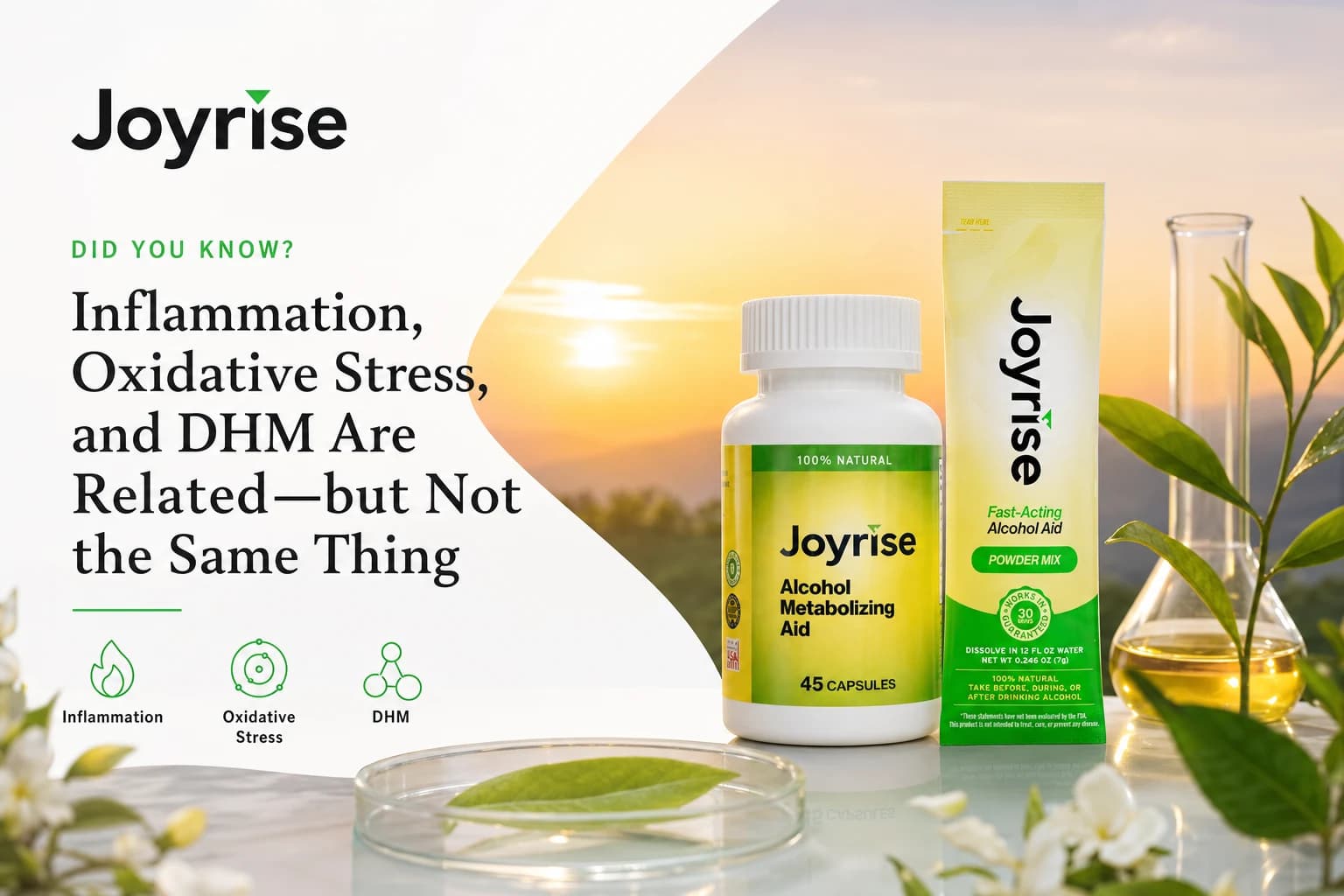
Did You Know? Inflammation, Oxidative Stress, and DHM Are Related—but Not the Same Thing
Inflammation, oxidative stress, and DHM (dihydromyricetin) are connected in research—but they are three different things. Oxidative stress is a chemical imbalance of reactive molecules. Inflammation is an immune and tissue-response process. DHM is a plant flavonoid studied for how it may interact with pathways that include both. Mixing the terms up makes supplement claims sound stronger than the evidence, and it makes wellness decisions harder than they need to be.
If you are researching DHM for responsible alcohol-support routines, this distinction matters. Alcohol metabolism can increase both oxidative load and inflammatory signaling in the body. That does not mean a supplement “turns off inflammation,” “detoxes” you, or replaces sleep, food, hydration, or moderation. It means the biology is layered—and accurate language helps you evaluate research without hype.
Designed for alcohol metabolism support
Joyrise capsules deliver our patented bioavailable DHM for alcohol metabolism support and next-morning clarity support. Follow the serving size, timing, and daily limit on your purchased Joyrise label.
Quick definitions you can cite
Oxidative stress is a state in which reactive oxygen species (ROS) and related reactive molecules outpace the body’s antioxidant defenses, increasing the risk of damage to lipids, proteins, and DNA.
In plain English: your cells constantly make reactive byproducts as part of normal metabolism. Antioxidant systems usually keep them in check. When production rises or defenses fall behind, that imbalance is oxidative stress.
Inflammation is the immune system’s coordinated response to injury, infection, or other stressors. It involves immune cells, signaling molecules (such as cytokines), blood-flow changes, and tissue repair programs.
Acute inflammation can be protective. Problems often arise when inflammatory signaling becomes excessive, poorly resolved, or chronically elevated. Inflammation is a biological process, not simply “too many free radicals.”
DHM (dihydromyricetin, also called ampelopsin) is a flavonoid compound found in multiple plants. Joyrise identifies its source as Vine Tea (Ampelopsis grossedentata). DHM has been studied in cell and animal models related to alcohol exposure and metabolic pathways; directly applicable human clinical evidence remains limited.
DHM is an ingredient, not a synonym for anti-inflammatory action or antioxidant status.
How oxidative stress and inflammation are related (without being identical)
Think of them as neighbors that talk to each other—not as two names for the same house.
1. Oxidative stress can promote inflammatory signaling. Damaged molecules and ROS can activate pathways that turn on immune-response genes.
2. Inflammation can increase oxidative load. Activated immune cells deliberately generate reactive molecules as part of host defense, which can spill into surrounding tissue stress.
3. Shared upstream triggers exist. Infection, tissue injury, metabolic strain, poor sleep, and alcohol exposure can push both systems at once.
4. Downstream feelings can overlap. Fatigue, fogginess, and “off” recovery days can track with many factors—dehydration, sleep loss, acetaldehyde exposure, glucose swings, and more—not a single lab label.
| Concept | What it is | Main “cast” | Common mix-up |
|---|---|---|---|
| Oxidative stress | Chemical redox imbalance | ROS, antioxidants, damaged biomolecules | Calling every antioxidant claim “anti-inflammatory” |
| Inflammation | Immune/tissue response program | Immune cells, cytokines, vascular changes | Treating it as only free-radical damage |
| DHM | Plant flavonoid under study | Compound + dose + formulation context | Assuming mechanism equals proven human outcome |
Where alcohol fits in the picture
Alcohol is relevant to this topic because drinking can stress multiple systems at once:
Metabolism burden: Ethanol is processed through pathways that can elevate reactive intermediates.
Acetaldehyde exposure: Acetaldehyde is a reactive ethanol metabolite associated with unpleasant after-effects; learn more in Joyrise’s explainer on what acetaldehyde is.
Sleep and recovery disruption: Even without dramatic next-morning symptoms, sleep architecture and hydration status can change how recovered you feel.
Immune signaling shifts: NIAAA explains that acute and chronic heavy alcohol use can alter immune responses, contribute to inflammation, and contribute to alcohol-related organ damage. This does not mean every drink produces a clinical inflammatory disorder ( NIAAA: Alcohol’s Effects on the Body).
None of this means every drink creates clinical inflammatory disease. It means “I feel rough tomorrow” is usually multifactorial. That is why responsible routines still start with moderation, food, water, and sleep—not a single molecule.
Where DHM research intersects oxidative stress and inflammation
This is the section most articles blur. Keep the evidence tiers separate.
In laboratory models, DHM has been investigated for effects on antioxidant-related pathways and inflammatory signaling markers. These studies can be useful for generating hypotheses—for example, whether a compound influences oxidative enzymes, redox-sensitive transcription factors, or cytokine readouts in a controlled model.
What preclinical work can suggest: possible mechanisms worth studying.
What it cannot prove alone: reliable benefits in everyday human drinking contexts.
Human data on DHM should be judged study-by-study: population, dose, form, duration, endpoints, and whether outcomes map to the claim being made. A finding in one model or endpoint does not automatically support broad statements like “DHM is anti-inflammatory in humans.”
Joyrise’s own content standards are strict on this point for good reason: anti-inflammatory benefit claims in humans need directly applicable human clinical support, and “clinically proven” language needs a trial that matches the exact claim.
For a transparent walk-through of mechanisms and evidence framing, see The Scienceand the core DHMpage.
A careful summary looks like this:
Oxidative stress and inflammation can amplify each other.
Alcohol-related stress can touch both domains.
DHM is researched in pathways adjacent to those domains.
Related pathways ≠ interchangeable terms ≠ guaranteed outcome.
That wording protects readers and keeps trust high.
Why the distinction changes how you shop and read labels
When marketing collapses three ideas into one vibe—“antioxidant anti-inflammatory hangover support”—you lose the ability to ask better questions:
Is the claim about a marker, a symptom, or a disease process? Those are different.
Was the evidence generated in cells, animals, or humans? Rank them accordingly.
Is the endpoint relevant to your use case? A pathway change in a dish is not the same as next-morning function after a night out.
Does the product discuss dose, timing, and formulation quality? Compound identity alone is incomplete. (If you are comparing practical use questions, Joyrise also covers when to take DHMand broader DHM hangover-relief educationwithout promising medical results.)
A practical framework: separate inputs, processes, and feelings
Use this three-layer model when you evaluate DHM content:
1. Inputs you control: alcohol amount and pace, food, water, medications/conditions, sleep opportunity.
2. Biological processes: ethanol/acetaldehyde handling, oxidative load, inflammatory signaling, circadian disruption.
3. Subjective outcomes: energy, clarity, stomach comfort, motivation next day.
Supplements, including DHM formats, sit in layer 2 as optional support tools under research—not as switches that erase layer 1 choices. If you want product discovery after you understand the science, start with education pages like DHM, then compare formats only after the mechanisms make sense.
What responsible takeaways look like
Use precise words. Say “oxidative stress” when you mean redox imbalance; say “inflammation” when you mean immune/tissue response biology.
Grade evidence out loud. Preclinical mechanism ≠ human clinical proof.
Reject absolute promises. No supplement replaces moderation, and nothing makes heavy drinking “safe.”
Prefer transparent brands. Look for clear ingredient identity, dosing context, and restraint on medical claims.
Keep the basics non-negotiable. Food, water, time, and sleep remain the foundation of next-day wellness.
Joyrise’s positioning is built around informed routines and owning tomorrow’s plans—not miracle chemistry. If DHM is part of your toolkit, let it be an evidence-aware choice paired with adult judgment.
FAQ
No. Oxidative stress is a redox (chemical) imbalance. Inflammation is an immune and tissue-response process. They can influence each other, but one term should not replace the other.
Not always in a simple one-to-one way. Significant or prolonged oxidative stress can encourage inflammatory signaling, but context, tissue type, and duration matter. Short-lived shifts can occur without meaning you have a clinical inflammatory condition.
DHM has been studied in models that include inflammatory signaling endpoints, especially in preclinical research. That is not the same as a blanket human “anti-inflammatory” benefit claim. Human conclusions require directly applicable clinical evidence for the specific claim.
DHM is a flavonoid investigated in antioxidant-related and redox-pathway research, including laboratory settings. “Antioxidant” can refer to chemical behavior in a test system or to meaningful effects in people; those are different standards. Check study type before accepting broad wording.
Because alcohol exposure can involve metabolic stress, reactive intermediates (including acetaldehyde-related stress), sleep disruption, and immune-signaling changes. Writers sometimes compress that complexity into one phrase. Better content separates mechanisms from outcomes.
No. Responsible education should not claim that DHM sobers you up, lowers blood alcohol concentration, treats alcohol poisoning, or makes drinking safe. Those are different biological and safety issues.
Start with Joyrise’s DHM overview, then The Science, and the acetaldehyde explainer. For timing questions, see when to take DHM. Browse more explainers in the Joyrise blog.
If you have liver disease, take prescription medications, are pregnant or trying to conceive, struggle with alcohol use, or have persistent symptoms after drinking, speak with a qualified healthcare professional. Supplements are not medical care.
Bottom line
Inflammation and oxidative stress are related biological domains, and DHM appears in research that touches pathways near both—but they are not interchangeable concepts, and pathway research is not a permission slip for oversized promises. Learn the definitions, rank the evidence, protect the basics, and treat DHM as one informed option within a responsible routine rather than a catch-all solution.
Evidence and source notes
PMID 37680900; DOI 10.3389/fnut.2023.1201007: Proof-of-concept study in female C57BL/6J mice, 12 per group, using a five-week Lieber-DeCarli ethanol-feeding model. DHM was added after two weeks of ethanol exposure at 6 mg/mL. The investigators reported changes in liver-related measures and lower TNF-α, IL-6, and IL-17 in the DHM group. Limitations: animal model, forced ethanol diet, short duration, and no test of Joyrise, human hangover symptoms, or a consumer serving. The result supports mechanistic interest only, not a human anti-inflammatory claim ( PubMed).
PMID 32267550; DOI 10.1111/acer.14326: Male C57BL/6J mice received intraperitoneal DHM at 5 or 10 mg/kg in an ethanol-feeding model; the paper also used HepG2/VL-17A hepatoblastoma cells. It reported changes in lipid, ethanol-metabolism, cytokine, and chemokine measures. Limitations: injection rather than an oral consumer product, mouse and cancer-cell models, and no test of Joyrise or human next-morning outcomes. It does not establish hangover relief, hangover recovery, BAC reduction, or faster sobriety in people ( PubMed).
NCT05623501: A small Phase I open-label dose-escalation registry in healthy volunteers focused on safety, tolerability, and pharmacokinetics. The registry record does not supply directly applicable controlled human evidence that DHM reduces inflammation or support after-drinking recovery, and it did not test Joyrise ( ClinicalTrials.gov).
NIAAA describes alcohol’s effects across immune and organ systems and explains that excessive use can contribute to inflammation and tissue injury ( NIAAA). Its hangover guidance identifies acetaldehyde as a toxic, short-lived byproduct and emphasizes that recovery requires time; no supplement makes drinking safe or produces instant sobriety ( NIAAA Hangovers).
Retraction/correction check: PubMed records for PMID 37680900 and PMID 32267550 showed no retraction or correction notice when checked August 12, 2026. Retracted PMID 31572805 is excluded and is not used as positive evidence.
Applicability to Joyrise: None of the cited studies tested Joyrise. No directly applicable human clinical study cited here establishes an anti-inflammatory benefit, hangover treatment, guaranteed hangover relief, or guaranteed hangover recovery for Joyrise or DHM.
Dietary-supplement and use notice: These statements have not been evaluated by the Food and Drug Administration. Joyrise is not intended to diagnose, treat, cure, or prevent any disease. Joyrise does not sober you up, lower BAC, treat alcohol poisoning, or make drinking safe. Moderation, food, hydration, sleep, time, and medical care when needed remain essential.
---
SEO Notes
Meta title: DHM, Oxidative Stress & Inflammation: What’s the Difference?
Meta description: Oxidative stress, inflammation, and DHM are related but not the same. Learn clear definitions, how alcohol fits in, and how to read DHM research without hype.
Designed for alcohol metabolism support. Made by Joyrise®.
Related: the science/ what is DHM/ DHM hangover relief/ hangover relief capsules.
Important: These statements have not been evaluated by the FDA. Joyrise is not intended to diagnose, treat, cure, or prevent any disease. Follow the exact product label. Joyrise does not reduce impairment or BAC.
Source trail
References and further reading.
Links are preserved from the article so readers can inspect the underlying material. A link does not mean every finding applies to Joyrise or predicts a finished-product outcome.
Suggested citation
Joyrise Science Team. “Did You Know? Inflammation, Oxidative Stress, and DHM Are Related—but Not the Same Thing.” The Joyrise Journal, August 12, 2026. https://www.joyrise.com/blog/did-you-know-inflammation-oxidative-stress-and-dhm-are-related-but-not-the-same