What does DHM research tell us about feeling calm?
Dihydromyricetin, usually shortened to DHM, is a plant flavonoid investigated in laboratory research involving alcohol and neural signaling. That makes it an interesting research subject. It does not establish that taking Joyrise treats anxiety, restores a person's brain chemistry, or reliably produces a calmer mood. Understanding the difference makes the science more useful than a promise about “balance” that never explains what was measured.
This guide focuses on the meaning of the research rather than turning everyday stress into a supplement diagnosis. Joyrise sells DHM-based products, so it has a commercial interest in the topic. The evidence discussed here should be judged by its methods and outcomes, independently of that interest. For symptoms specifically following alcohol, read the separate hangxiety guide.
GABA is a signaling system, not a mood gauge
GABA is a neurotransmitter involved in inhibitory signaling in the nervous system. GABA-A receptors are one part of that system. Researchers can study receptor activity in cells and tissue, but someone feeling tense cannot infer their personal GABA level from that feeling. Nor does “supports GABA” identify a tested clinical outcome without explaining the experiment behind the phrase.
Stress, poor sleep, alcohol exposure, medicines, and health conditions can overlap in a person's experience. A single receptor explanation cannot separate those possibilities. Treating every difficult morning as evidence of the same chemical deficiency skips the questions that matter: when symptoms started, how long they last, what else changed, and whether they interfere with normal life.
What the frequently cited 2012 experiment did
The Shen and colleagues study published in 2012 used rat and cell models to examine DHM, alcohol-related behaviors, and GABA-A signaling. Some rat experiments administered DHM by injection. These are preclinical methods, with controlled exposures and endpoints selected to investigate a mechanism. They are not the same as adults taking a retail capsule for ordinary stress.
Three details should travel with any summary: the subjects were not consumers, the administration route matters, and the outcomes were experimental measures rather than a demonstrated improvement in daily well-being. The paper supports further investigation. It does not establish a clinical dose for anxiety or verify that a finished Joyrise serving normalizes brain chemistry in a person.
Getting into the body is another question
An ingredient can influence a receptor under experimental conditions without reaching the same concentration after someone swallows it. A 2021 study in mice investigated oral and injected DHM and measured serum and brain exposure. Its results help explain why absorption deserves attention, while also showing why the route and species must remain visible.
There are several separate steps between a capsule and a claim about calm: the ingredient must be identified, exposure characterized, and the relevant human outcome measured. Evidence at one step does not fill every later step. An absorption comparison also needs the actual formulation and comparator, rather than borrowing a result from a different delivery system.
Everyday stress and alcohol-related anxiety need context
Alcohol can initially feel relaxing, yet anxiety can occur as its effects wear off. NIAAA's clinical overview of alcohol and mental health emphasizes the timing of symptoms and the relationship between drinking and underlying conditions. Anxiety after drinking is not proof that the solution is another drink or a supplement that invokes GABA.
If an anxious period happens without alcohol too, that is relevant information rather than a reason to expand a hangover-product claim. Recurrent or distressing symptoms deserve individual assessment. A clinician can consider history, medicines, sleep, alcohol use, and other factors that a product page cannot evaluate. A supplement should not delay that conversation or replace prescribed care.
How to evaluate a claim about balance
Ask what “balance” means in the study. Was it a receptor recording, an animal behavior test, a validated human symptom scale, or simply a reviewer's description? Those measurements are not interchangeable. A claim becomes easier to assess when the outcome is specific enough that a study could show it did not happen.
Next, identify who received what. An extract, purified DHM, and a multi-ingredient formula are different interventions. Look for the duration, comparison group, number of participants, and adverse-event reporting. A before-and-after anecdote cannot separate a product's effect from changes in sleep, alcohol intake, expectations, or the natural passage of time.
Finally, check whether the commercial wording stays within the result. A patent concerns an invention; it does not function as a trial of calm. Product testing can document identity or quality without demonstrating a mental-health benefit. An honest explanation should make those categories easier to distinguish, even when the distinction makes a marketing headline less dramatic.
Where Joyrise belongs in that picture
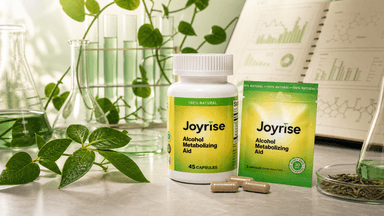
Joyrise is a dietary supplement intended for alcohol metabolism support. Its current product label determines serving directions. It is not an anxiety treatment, a substitute for sleep, or protection from alcohol-related impairment. Do not increase servings to pursue a mood effect that the cited research has not established.
For a useful personal record, note sleep, alcohol timing, symptoms, and medicines without trying to assign a neurotransmitter diagnosis. That record can support a clinical discussion if problems persist. If there is severe confusion, inability to wake, seizures, or slow or irregular breathing after alcohol, seek emergency help. Those signs require immediate assessment, not an experiment with a wellness product.
Questions readers ask
Does DHM increase GABA in people?
The cited experiments concern GABA-A signaling under laboratory conditions. They do not establish that a consumer serving raises a person's GABA to an ideal level or treats their anxiety. Receptor activity and a clinical outcome are separate measurements.
Is this evidence for taking Joyrise every day for stress?
No. The research summarized here does not establish that use. Follow the purchased product's label and seek qualified advice about ongoing stress or anxiety. For a broader explanation of the ingredient, see what DHM is and how it has been studied.
Important: These statements have not been evaluated by the FDA. Joyrise is not intended to diagnose, treat, cure, or prevent any disease. Follow the exact product label. Joyrise does not reduce impairment or BAC.
Source trail
References and further reading.
Links are preserved from the article so readers can inspect the underlying material. A link does not mean every finding applies to Joyrise or predicts a finished-product outcome.
Suggested citation
Joyrise Science Team. “DHM, GABA, and a Balanced Mind: What the Research Shows.” The Joyrise Journal, October 29, 2025. https://www.joyrise.com/blog/calm-after-the-chaos-how-joyrise-and-dhm-support-a-balanced-mind